
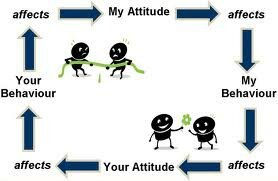
 As I was telling you in my previous post, personal journeys can affect relationships. I have witnessed a lot of people embarking on a deep meaningful path and soon after breaking up with their partner. Fortunately, it doesn’t necessarily have to be that way, and NLP provides some great tools to improve your relationships.
Here are a few tips that can be useful for a better communication:
- When talking about the issues with her husband, the client I was telling you about in my previous post was complaining that he never asked how our sessions went. She said “I know he doesn’t ask how my session went because he doesn’t care”. Her husband actually never stated those words, and she simply projected her deepest fears onto him. I challenged her by asking if she thought it was possible that there was at least one other explanation to why he wouldn’t ask. And of course, she realised that he might simply want to give her privacy; or that he was forgetful; or he was scared to ask in case she wasn’t care on sharing… You get the picture
 Mind reading can be deceitful and lead to conflicts. When you hear yourself talking in this way, make sure you’ve got hard evidences to support your statement. Or more likely, start to wonder what other explanation there could be for their behaviour…
 - Have you ever heard someone saying something like: Every time I come home, he’s sitting in front of TV? This is a dangerous generalisation, as it’s very unlikely it happens every time and those words aggravate the issue instead of helping sorting it.
- I often hear the statement: He makes me angry. I’m intrigued: technically, how do people have the power to make you do or feel something? If it exists, I do want to learn it…
 People can only make us feel or do things if we implicitly agree to do so. NLP teaches us that we are in charge of our thoughts and feelings, so if you choose not to feel angry, well guess what? You have the power to do it.
 - There’s one NLP presupposition that I find very useful in my interaction with people: “Every behaviour has got a positive intention”. So whenever someone says or does something that I struggle with, I remember that they must have a positive intention, either for themselves or for me. And if I find it, it might give me the key to move forward in solving the issue.
- Another great presupposition is “People respond to their experience, not the reality itself”. In relationships people can push each other’s buttons, and it’s very helpful remembering that most of the time when people react strongly, they’re likely to respond to an old pattern rather to what you just said. It helps putting things into perspective and not take their response too personally.
- NLP suggests that we all tend to have a preferred representational system. I remember hearing the story of a husband that kept leaving a mess in the leaving room, and his wife, who was very visual, was very bothered. But he couldn’t understand how it affected her, as he was himself very kinaesthetic. So when she told him that seeing the mess was like feeling crumbs in the bed, he immediately got the message and worked on changing his habits! That shows that it can be useful to learn what your partner’s preferred representational system is and use corresponding predicates to facilitate the communication.
- When you’re about to have a delicate conversation, pay attention to your body posture, keeping it open. Matching your partner’s behaviour unconsciously sends the message that you’re on their side and looking for agreements rather than arguments. Always start the conversation with stating how you feel and what is going on for you rather than blaming them. So in the example of my client, rather than starting the conversation by saying “You never ask how my session went”, that will necessarily trigger some defensive response, she could say “ I’ve noticed that we haven’t talked recently about my sessions, and I’d love to share them with you, what do you think?” That’s much more accepting and loving, and likely to trigger an openness and trust that is crucial in handling conflicts successfully.
Hope you enjoy those tips, and please let me know how you get on with them!