5 tips to boost your self-esteem

Having explored the difference between confidence and arrogance in my previous post, and hopefully having helped you to accept the idea that’s is ok to become more confident, let’s look today into how you can increase your self-esteem and self-confidence.

1. Make a list of your qualities and achievements. For example, writing down that you are kind, funny or creative. And recognising achievements such as graduating from school or passing your driving test. Even though those qualities and achievements might seem to you as trivial, they still represent what you are good at. No matter if they are common skills or attributes. When you look at your flaws, you probably don’t dismiss them because others have it too; do you?! So why would you do that for your qualities?!

2. Ask people you love and trust to give you a list of the qualities they think you have. You might be surprised on how much more positively people who love you see you than you see yourself…

3. Look into the negative beliefs you have about yourself, such as “I’m not good enough”, “I’m not loveable”, “I don’t deserve being (successful, happy etc…)”. Where do those beliefs come from? What negative messages have you received as a child and from whom? Start to look for counter evidences for those beliefs in your everyday life, such as for example what you’ve already achieved that show you are indeed good enough. Or how many people love you that prove that you are indeed loveable…

4. Take one of this limiting beliefs and ask yourself: what would it take for this belief to be false? For example, taking the belief “I’m not loveable”. What would it take for anyone to be loveable according to your criteria? How can you then relate this to yourself?

5. Finally if those beliefs are deeply engrained, ask an NLP master practitioner to help you sorting them out. There are many brilliant processes that can help you re-program your mind to get some more positive and useful beliefs.

I hope that helps, looking forward to reading your feedbacks!
Confidence vs. Arrogance

One of the most common issues people bring in therapy is lack of confidence. Whether it’s confidence in themselves or confidence in doing something. And that is generally closely linked with a lack of self-esteem.

What’s the difference between self-esteem and self- confidence? My interpretation of it is that self-esteem is the ability to recognise one’s qualities, and self confidence is the ability to recognise one’s skills and abilities in doing something.

I often encourage my clients to first work on their self-esteem as I see it as the door to having more confidence. When I ask my clients how confident they feel on a scale 0 to 10, at first they rarely reach further than a 6 or 7 at the best. And when we explore what stops them from being confident up to a 9 or a 10, one of the first answer I get is “If I’m too confident I’m scared of becoming arrogant.” sounds familiar?

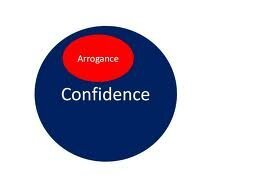
Therefore it’s quite important to explore the differences between arrogance and confidence. How would you describe the difference?

After having asked that question to many clients and to my NLP course students over the years, I noticed that the difference can be summed up in a simple statement: Being arrogant is stating your strength and qualities whilst putting down the interlocutor, whilst being confident is simply acknowledging your strength and qualities. Hence the main difference between being arrogant and confident is the intention behind the statement you make.

In my next post I’ll share some tips on how to boost your self-esteem and your self-confidence, but in the mean time, I’m interested to hear your thoughts on that topic; Do you have another way to explain the difference between the two? I’m looking forward to engage in a fascinating discussion with you, so please drop me a line in the comment section!

It’s not you, it’s me

My client this morning brought an interesting dilemma. He was at work last week and one of his customer asked his opinion on other traders in the field. Having a nice rapport already with that regular customer, my client allowed himself to share his thoughts on that subject, which actually weren’t very positive…

On his way home, he got a bit worried, wondering if he had done the right thing in being so honest on that topic with a customer. He asked his girlfriend her opinion and she got very wound up and angry with him, criticising the fact that “he always talks too much”. My client was puzzled as her reaction seemed overly strong and felt very guilty about it all. He immediately asked me to schedule an appointment.

When John went into details about the story, it seemed he couldn’t find any controversy in what he had shared with his customer, as he was very careful in not mentioning any names and only giving a general opinion. Through some coaching, we quickly realised that John didn’t think there was an issue in him talking too much actually, he had simply adopted his girlfriend’s beliefs that he did something wrong.

Digging deeper it appeared that a few months ago, John had shared with his best friend that his girlfriend had previously suffered from depression. Justine got very upset as she understandably felt quite protective of this aspect of her life ; she probably felt betrayed in being exposed to a third party without her permission. And since that incident, she had been very sensitive every time John was openly sharing some information.

That was quite a breakthrough for John as he actually realised that her criticism had actually not much to do with him, but simply was showing the fact that his girlfriend had some issues – that can be very legitimate – around her depression and him sharing some private information. It is therefore important to recognise the difference between what others believe are right or wrong and what we stand for.

I’ve read a wonderful quote recently that sums up very well the dynamic of this pattern: “When people predict your doom, undermine your dreams or criticise you, remember they’re telling you their stories, not yours.”

We all have a different model of the world and our reactions to external events are bound to be influenced by our subjective perceptions. Our beliefs and values, our past experience and much more will shape how we interpret events and how we respond to them. So most of the time our reactions are merely the mirror of what’s going on in our internal experience rather than a detached response to what’s presented to us.

But too often we mistake the map for the reality and try to impose our beliefs on others by criticising them when they don’t behave according to our standards. Sometimes we may simply forget that they follow their values which are simply different from ours, but as valid…

Have you ever been in such a situation? I’m interested to hear your thoughts!


Do you want to play the Unconscious mind game?

There’s a challenge I’ve been facing quite often when working with the unconscious mind using NLP and hypnotherapy. As I mentioned before, I use hypnosis as a door to the unconscious mind, because I’ve found that engaging that part of our mind in making changes is much more effective than just working at the conscious level.

Coming back to the 81 years old client I was telling you about last time, I learnt something very important whilst working with her recently. One of the very powerful processes of NLP-hypnosis is the Part integration process. It addresses the unconscious mind to find the positive intention behind an unwanted behaviour and helps to solve the internal conflict the person is experiencing, between the part of them that’s creating the unwanted behaviour, and the part of them that doesn’t want to have this behaviour any more.

Unlike some NLP practitioners, I like to perform this process under trance, as it allows a deeper connection with the unconscious mind thus deeper changes. So the first time I applied this process with my client, I faced an issue that is quite common. Instead of allowing her unconscious mind to communicate with me, she was only giving me conscious responses. Which can undermine the success of the treatment as we’re not treating the issue at its source. I applied my usual tricks but nothing seemed to work. It can be helpful to get conscious replies, don’t get me wrong, but it doesn’t necessarily solve the problem, especially when like in this case, the issue is deeply rooted in the unconscious mind.

As a result, my client improved, but either the changes didn’t last nor were they significant. At first, I couldn’t figure out what was going wrong, but quickly I realized that being from an older generation and a different culture she didn’t really grasp the concept of the unconscious mind. I then decided to use some more “rational” processes such as submodalities shift or changing her strategies and we then got some brilliant results. However there was always a little part of her that she couldn’t control and that would escape from the brilliant set of NLP tools I was using.

I then asked myself “how can I get her to get familiar with unconscious verbal communication”? It’s quite a tricky one as it is, in essence, unconscious…So I made her do this funny exercise inspired from a game I saw in a famous TV series…I asked her simple questions and she had to answer with the first thing that came to her mind. That way she got familiar with how it feels to let the unconscious mind speak first and since then we’ve managed to do some deep part and core transformation processes!!

Moral of the story? never underestimate the resources of TV series… ;-)

Believing in your clients

I’d like to share with you a case study that illustrates very well the person centred NLP approach, especially the fourth of the six Sufficient and Necessary Conditions for change inspired by Carl Rogers: That the practitioner believes unconditionally that their client can change from within. It also illustrates very well the NLP presupposition that says “you can’t not communicate”.

I’ve got a client who is 81 year old and wants to lose weight. She’s an absolutely incredible woman and has got an amazing energy and joie-de-vivre. In her quest for happiness, she’s decided to fight her binging pattern and to get fit. I must say that she’s not binging much and generally eats healthy food, but she ‘s unhappy not to be in control of herself in those situations.

After having checked that the changes she wanted were ecological, we started to work using different NLP and hypnosis processes. She started to change, and as I got to know her and her learning style, I discovered that in her model of the world, change had to come progressively and be reinforced regularly in order to last. So I adapted my processes in order to match her beliefs and we got very good results: she was gradually improving, reducing drastically the episodes of binging and being much more in control of her eating habits.

One day she burst into my practice with a huge grin on her face and before even sitting down started to tell me how happy she was, as she had just been on a cruise and completely controlled her eating pattern: not once did she have something unhealthy. As she told me about those good news, I couldn’t help feeling sceptical as it just didn’t fit with what I knew from her learning style, and I found quite amazing that she got suddenly such drastic and quick results when we had been working for months achieving baby steps. As I was contemplating all those thoughts, guess what happened? Well, my unconscious communication couldn’t have been more transparent.

And as soon as I realized it I tried to make up for it and consciously support and congratulate her as much as possible. But it was too late. My own beliefs had polluted her experience, and as we had created a great rapport over the months we worked together, she immediately picked up on it. And as a result, completely relapsed and went back to square one. What a lesson learnt!! It is indeed so important as a practitioner to leave your own beliefs and expectations at the door and offer unconditional positive regards to your clients!

Thanks to our good rapport however I managed to reframe positively what had just happened, but it took me another few weeks to get her back on track, as she had developed now the belief that she had failed therefore that she was never going to make it…She is now much better and much happier, and I’ve learnt something very important out of it. Clients are indeed your best teachers!